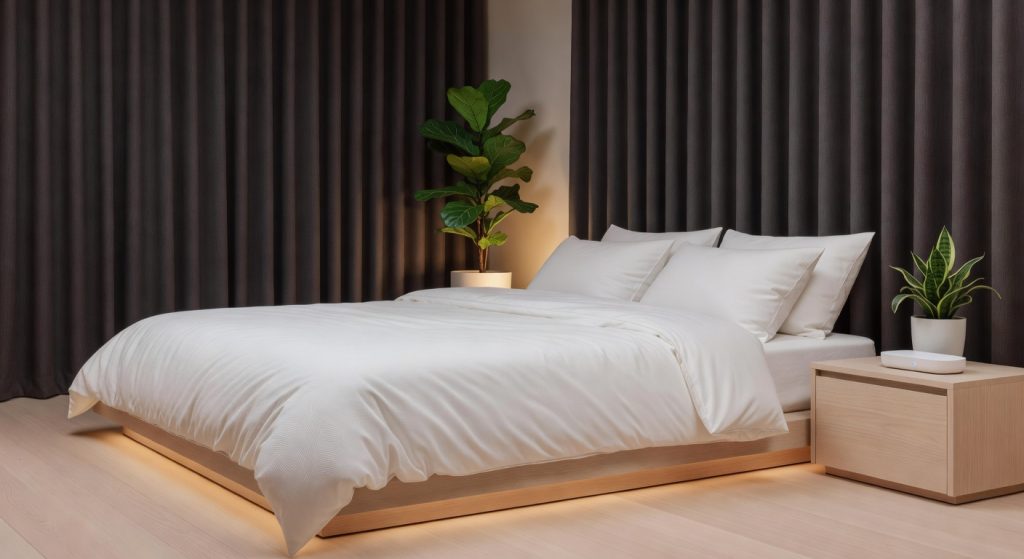
Your sleep environment is one of the most powerful — and most overlooked — factors that determines how well you sleep. Research from the National Sleep Foundation shows that 93% of adults rate a comfortable mattress, cool temperature, and quiet environment as critical to good sleep. Yet most people never optimize their bedroom systematically.
The 5 Pillars of Sleep Environment
| Factor | Optimal Range | Effect on Sleep | Easy Fix |
|---|---|---|---|
| 🌡️ Temperature | 16–19°C (60–67°F) | Triggers melatonin, deepens NREM sleep | Open window or use fan |
| 🔇 Sound | < 30 dB (library quiet) | Reduces micro-arousals and cortisol spikes | White noise machine or earplugs |
| 🌑 Light | < 1 lux during sleep | Prevents melatonin suppression | Blackout curtains + eye mask |
| 💨 Air Quality | CO₂ < 1000 ppm, RH 40–60% | Reduces sleep fragmentation | Ventilate before bed, plant or humidifier |
| 🛏️ Mattress Age | Replace every 7–10 years | Reduces back pain + pressure points | Audit sag, spring noise, morning stiffness |
1. Temperature: The Most Underrated Sleep Factor
Your body must drop its core temperature by 1–2°C to initiate and maintain sleep. This is driven by circadian biology — your hypothalamus signals vasodilation (heat loss through hands and feet) as darkness falls.
A 2021 NIH-funded study at University of Southern California tracked 765,000 nights of sleep data and found that warmer ambient temperatures directly correlated with shorter sleep duration and lower sleep efficiency — even when people felt they slept fine.
Practical action: Set your thermostat to 18°C an hour before bed. If that’s not possible, use moisture-wicking bedding (bamboo or Tencel) and keep the window cracked. A breathable latex or pocket spring mattress adds 3–5°C lower surface temperature versus dense foam.
2. Light Exposure: Melatonin’s Worst Enemy
Blue-spectrum light (phones, LED bulbs, streetlights) suppresses melatonin production via photoreceptors in the retina called intrinsically photosensitive retinal ganglion cells (ipRGCs). A landmark Harvard study by Charles Czeisler et al. found that even dim light exposure at night — as low as 8 lux — can reduce melatonin levels by up to 50%.
- Use blackout curtains — light from a streetlamp can reach 100+ lux through thin curtains
- Enable Night Shift / f.lux on all screens after 8 PM
- Replace bedroom bulbs with amber/red-spectrum LEDs (3000K or below)
- Use a sleep mask if full darkness isn’t achievable
3. Sound: The 30dB Rule
The World Health Organization recommends bedroom noise below 30 dB for uninterrupted sleep. Traffic, snoring partners, and thin walls routinely push rooms to 45–60 dB — enough to cause micro-arousals that prevent deep NREM (Stage 3) sleep even if you don’t wake up consciously.
White noise machines work by masking noise variation (it’s the sudden changes in sound, not sustained noise, that cause arousals). Studies show white noise can reduce sleep onset time by 38% in noisy environments.
4. Your Mattress: The Foundation of Everything
A study published in Journal of Chiropractic Medicine (2009) followed 59 healthy adults who replaced their old mattresses (>5 years) with medium-firm new ones. Results after 28 days:
- Back pain: 57% reduction
- Sleep quality: 60.8% improvement
- Sleep efficiency: Increased from 71% to 83%
The right mattress depends on your sleep position. See our full mattress range — from pocket spring for combination sleepers to latex for temperature-sensitive sleepers.
Quick Bedroom Audit Checklist
- Temperature check: Is your bedroom 16–19°C at bedtime? If you wake up sweating, it’s too warm.
- Light audit: Can you read a book by the ambient light with the lights off? If yes, it’s too bright.
- Sound test: Record 30 seconds of audio at 2 AM — listen for spikes above conversation level (60 dB+).
- Mattress sag test: Place a straight edge across the mattress surface — gaps > 3 cm mean it’s past its prime.
- Air quality: Does the room feel stuffy in the morning? Consider a CO₂ monitor — over 1000 ppm disrupts deep sleep.
Sources
- National Sleep Foundation, Sleep in America Poll 2020
- Harding, E.C. et al. (2020). The temperature dependence of sleep. Frontiers in Neuroscience.
- Czeisler, C.A. et al. Exposure to Room Light before Bedtime Suppresses Melatonin Onset. Journal of Clinical Endocrinology & Metabolism, 2011.
- Jacobson, B.H. et al. (2009). Effect of Prescribed Sleep Surfaces on Back Pain. Journal of Chiropractic Medicine.
- WHO Environmental Noise Guidelines for the European Region, 2018.
Frequently Asked Questions
What is the ideal bedroom temperature for sleep?
The ideal bedroom temperature for sleep is between 16–19°C (60–67°F). This range helps your body lower its core temperature, which is essential for initiating and maintaining deep sleep.
How does light affect sleep quality?
Blue-spectrum light suppresses melatonin production. Even 8 lux of light exposure at night can reduce melatonin by up to 50%. Use blackout curtains and amber-spectrum bulbs to protect melatonin levels.
How does noise affect sleep?
Noise above 30 dB causes micro-arousals that prevent deep NREM sleep. White noise machines mask disruptive sound changes and can reduce sleep onset time by up to 38%.
How often should I replace my mattress?
Mattresses should typically be replaced every 7–10 years. Signs you need a new mattress include visible sagging, spring noise, morning stiffness, and worsening sleep quality.