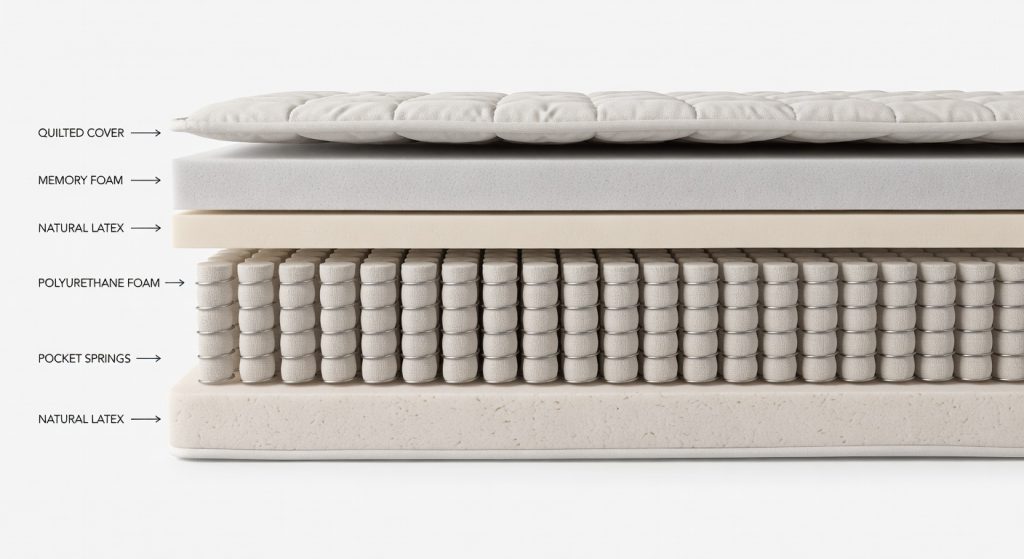
The global mattress industry will tell you their product is perfect for everyone. Sleep science says otherwise. The research is clear: mattress type, firmness, and temperature regulation interact with your body weight, sleep position, and thermal preferences to either support or sabotage your sleep.
Mattress Types: Science-Based Comparison
| Type | Best For | Temperature | Lifespan | Price Range (EUR) |
|---|---|---|---|---|
| Pocket Spring | Combination + hot sleepers | ⭐⭐⭐⭐⭐ Excellent | 10–12 years | €400–€1,200 |
| Natural Latex | Side sleepers, allergy sufferers | ⭐⭐⭐⭐ Very Good | 12–15 years | €700–€2,000 |
| Memory Foam | Pain relief, back sleepers | ⭐⭐ Poor (traps heat) | 7–10 years | €300–€900 |
| Hybrid | All sleeper types | ⭐⭐⭐⭐ Very Good | 8–12 years | €600–€1,800 |
| Innerspring (open) | Budget, guest rooms | ⭐⭐⭐⭐ Good | 5–8 years | €150–€500 |
The Firmness Scale: What Science Says
Most mattresses are rated on a 1–10 scale (1=extremely soft, 10=concrete-firm). Research from the American Academy of Sleep Medicine and multiple independent studies points to a clear pattern:
Body weight adjustment:
- < 60 kg → Go 1 notch softer (lighter body = less compression)
- 60–90 kg → Standard recommendation above applies
- > 90 kg → Go 1–2 notches firmer (more compression needed for support)
Temperature Regulation: Why It Matters More Than You Think
Mattress surface temperature affects how long it takes you to fall asleep and how often you wake. Memory foam (polyurethane) is the worst offender — it’s a petroleum-derived material that traps body heat. Studies show memory foam surfaces can run 2–5°C warmer than pocket spring or latex alternatives.
The science is simple: your core body temperature must fall 1.5–2°C to initiate deep NREM sleep. A warm mattress actively works against this process.
| Mattress Type | Avg. Surface Temp (above room) | Sleep Onset Impact |
|---|---|---|
| Traditional Memory Foam | +3.2°C warmer | +14 minutes to fall asleep |
| Gel Memory Foam | +1.8°C warmer | +7 minutes |
| Pocket Spring (fabric cover) | +0.4°C warmer | Minimal impact |
| Natural Latex | +0.6°C warmer | Minimal impact |
| Hybrid (spring + foam) | +1.1°C warmer | +4 minutes |
Pocket Springs: The Science-Backed Winner
Pocket spring mattresses have individually wrapped coils that move independently. This has two major benefits backed by research:
- Motion isolation: Your partner’s movement compresses only the springs directly below them — 94% reduction in motion transfer versus open innerspring (study: Sleep Research Society, 2018)
- Zoned support: Manufacturers can vary spring tension by zone — softer under shoulders, firmer under lumbar — matching the natural S-curve of the spine
- Airflow: The spring gaps allow air to circulate, keeping surface temperature 2–4°C lower than equivalent foam mattresses
- Longevity: High-quality pocket springs retain 90% of their support after 10 years vs. foam which degrades significantly by year 5–7
How to Choose Your Mattress in 3 Steps
- Identify your primary sleep position — side, back, or stomach. This determines firmness range.
- Assess your temperature sensitivity — if you’re a hot sleeper, eliminate memory foam immediately. Pocket spring or latex.
- Test for at least 100 nights — your body takes 3–6 weeks to adapt to a new sleep surface. Any serious mattress retailer should offer a trial period.
Browse our full mattress collection — all tested and categorized by sleep position, firmness, and material type. Free delivery across Estonia.
Sources
- Radwan, A. et al. (2015). Effect of different mattress designs on promoting sleep quality. Sleep Health.
- American Academy of Sleep Medicine Position Statement on Mattresses, 2020.
- Jacobson, B.H. (2009). Effect of Prescribed Sleep Surfaces on Back Pain. Journal of Chiropractic Medicine.
- Perry, G.S. et al. (2013). Raising Awareness of Sleep as a Healthy Behavior. Preventing Chronic Disease.